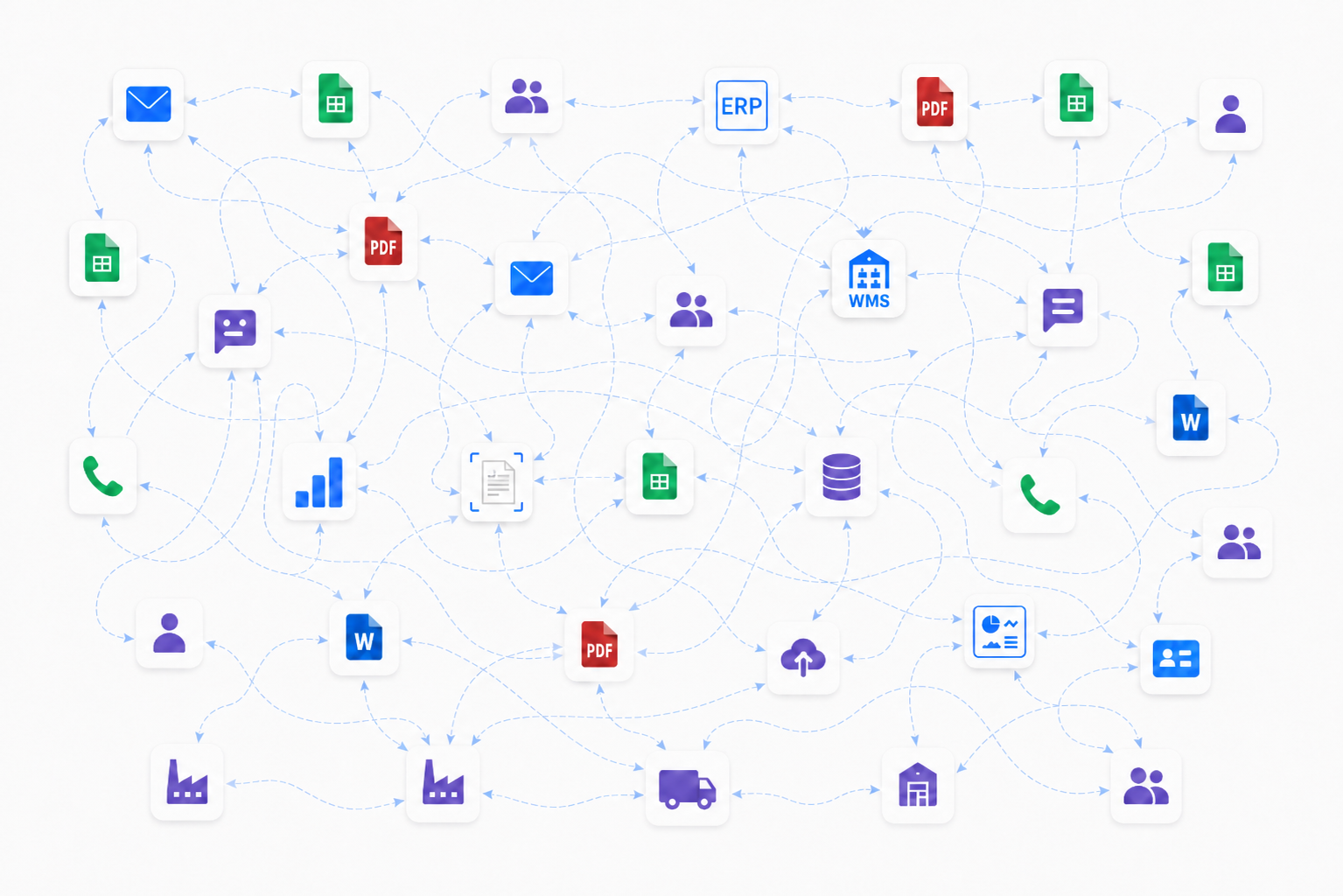
Effective exception management requires rapid adaptation. The current state informs decisions, which drive actions, which shape the next state. Doing this successfully depends on teams, systems, and partners staying aligned as conditions change. The challenge is partly data, but largely coordination.
Analytics dashboards and control towers fall short because, even with a strong data foundation, visibility is just the beginning. The work that follows determines whether teams can resolve the exception while it’s still cheap to fix.
Drawing on dozens of operator conversations, here’s what teams are dealing with, why the current model fails, and what needs to change.
The absence of a signal is often the only signal.
Teams frequently find issues only because someone goes looking for answers. One supply chain leader discovered a delay only when their planner asked about the order. It “just sat there unscheduled for several weeks.”
When a problem arises, the SOP isn’t always “call the supplier.” Often, the team must verify the PO and check with the warehouse first. This is painful and time-consuming.
Operators don’t have the capacity to hunt for every exception. When these problems aren’t detected automatically, they can remain hidden for days, sometimes weeks, before surfacing.
On the flip side, too many false positives are just as distracting. When everything is an exception, nothing is.
Teams are stuck in the same manual loop. On repeat.
Before operators can act, they have to chase missing details and reconstruct the issue from fragmented data. Was the order acknowledged? Did the date change? Was it shipped but not received? Is the inventory physically there but missing from the system?
Each question sends the operator somewhere else: the ERP, a spreadsheet, an email thread, a supplier, the warehouse, or another internal team. Once they know what happened, they must assess the impact, decide what matters, and determine what to do next.
Chase → verify → assess → decide → act.
This manual loop repeats across suppliers, orders, and customer commitments. Think of this as a coordination tax. It's paid with every exception, and compounds as work expands across teams.
Time leaks across the workflow. Risk accumulates at handoffs.
Missing signals delay detection, unreliable data slows verification, and chasing suppliers prolongs the response. By the time the problem is understood, the window to resolve it cheaply has closed, leaving fewer options and greater downstream risk.
That risk increases further because visibility and accountability gaps cluster at handoffs.
When information is scattered and coordination is manual, context gets lost, ownership becomes unclear, and work stalls between teams. More time is spent piecing together what happened while the issue continues to drift.
During a raw material shortage, time was lost in data dives, alignment meetings, and manual handoffs. According to one manager, the “data dive was only part of the problem”. The other was “multiple meetings that burn up daylight” for suppliers and cross-functional teams.
The gap isn’t data. It’s clarity.
Supply chains don’t lack data. They lack actionable information they can trust.
Data is often late, incomplete, or unreliable. In part, this is because of weak governance and controls. It is also because the long tail of suppliers still operates through email, spreadsheets, PDFs, and portals.
Automation has its own limitations. ASNs arrive after delivery, PO acknowledgments and invoices contain incorrect line-level details, backflushing deducts BOM quantities instead of actual usage, and EDI maps change without warning. Many implementations feel perfunctory, designed to check a compliance box rather than produce trusted and actionable data.
The issue isn’t just bad data. It’s also missing data.
Suppliers forget to send commits or ship notices, and PO changes often go uncommunicated. Goods receipts are entered late, and inventory is consumed but not deducted. The list goes on.
When a problem surfaces, teams must first connect the dots across fragmented datasets to determine what is true. Even detecting simple invoice discrepancies require stitching together ERP data, spreadsheets, contracts, email history, and input from the warehouse receiving team.
More data does not solve this.
The real gap is turning the available data into actionable information. As one operator put it, “The biggest thing was the lack of information on what is actually happening… you can’t do anything if you have no idea what’s going on.”
The dots only connect in people’s heads.
The individual tasks are rarely difficult. Checking a purchase order, emailing a supplier, or confirming a delivery with the warehouse is routine.
The difficulty comes from doing this across suppliers when information is scattered. In one example, the team checked SAP and the dashboard, traced where the product went, called different locations, and searched for “ghost stock” being held off-system.
This is why routine work becomes exhausting.
Teams are stitching everything together in their heads while juggling competing issues. The hard part is connecting all the dots without allowing anything to fall through the cracks.
It’s not what’s late that matters. It’s what breaks next.
In supply chain operations, almost everything’s a little early or a little late. Very little happens exactly on schedule. That is how the real world works.
Operators need to know which exceptions matter and what happens if they wait.
A variance against the plan, even past threshold, shouldn't qualify as a meaningful exception without first assessing the magnitude of impact and the cost of waiting. Without both, every alert competes for the same attention.
Constantly reacting and context-switching leaves no room for judgment.
The right response depends on material criticality, customer impact, supplier constraints, margin, and available alternatives. Teams lose valuable time reconstructing this context across suppliers, systems, and internal teams. That leaves less time to weigh options and make thoughtful decisions.
Companies hire great operators, then bury them in manual workflows that leave little room to exercise good judgment. When that room disappears, teams are cornered into using the few expensive options left.
Delay compounds like high-interest debt.
The longer an issue remains unresolved, the fewer options teams have and the more expensive each option becomes.
A material shortage identified early might require a supplier call or a minor schedule adjustment. Found later, it becomes air freight. Left unresolved longer, it stops production or disrupts a critical customer commitment.
Teams lose that resolution window because so much manual work happens before anyone can act. By the time the problem is understood and ownership is clear, a manageable issue may have already snowballed into a costly one.
In one case, “the heat was on” before the team could act. Installation was already delayed, leaving them willing to pay whatever was necessary to get the product shipped and expedited. They even considered sending their buyer to China to “sit with the supplier.”
The current model resolves exceptions, but never learns from them.
Because exception resolution is scattered across systems and conversations, it is difficult to reconstruct what happened. The investigation, verification, impact assessment, decisions, handoffs, and follow-through leave no usable audit trail. Who found the problem? What did they learn? Which options were considered? Who decided what, and when? Most of that valuable context is never captured.
SOPs rarely help. They don’t reflect how teams actually resolve exceptions and are rarely updated unless it’s a regulatory requirement.
You cannot redesign work if it isn’t captured. Documenting how these issues are actually resolved is the first step toward improving the process and imagining a better way of working.
Operators solve the immediate problem, but the organization learns nothing. The work disappears, the process stays broken. When the fire inevitably returns, so does the improvised response.
Most solutions stop where the real work begins.
There are two reasons why exception management is broken: lack of trusted information and manual coordination.
Most solutions solve neither. They rely heavily on data already captured in systems, ignore information buried in emails, spreadsheets, PDFs, portals, and threads, and surface data-quality problems without helping resolve them. Business process owners know what good data looks like, but they’re not data specialists, and most companies aren’t set up to manage data quality in real time. Teams are left with unreliable insights until someone fixes the underlying issues.
Even when the data foundation is strong and exception detection is reliably automated, most solutions stop at visibility, which only identifies the problem.
The real work is coordinating the response: aligning stakeholders, assessing risk, weighing tradeoffs, managing handoffs, and driving the issue to resolution. Today, much of that work happens manually through emails, meetings, and threads, leaving critical context outside systems of record.
Solutions have to run the entire loop.
This can’t be another dashboard or control tower that only stops at the insight. The goal should be to remove the chasing, reconstruction, and coordination that crowds out judgment and increases risk.
The solution must pull from wherever the data lives, fix what it can, flag what it can’t, and keep every change traceable. Scattered updates become a single verified timeline, with impact already mapped, so teams can focus on the exceptions that carry real risk.
From there, it automatically routes the exceptions that matter through the channels teams already use, with impact and tradeoffs attached. By keeping stakeholders aligned through resolution, it gives teams the bandwidth to make important decisions.
Every signal, decision, and action becomes part of an immutable audit trail. The organization doesn’t just resolve the exception. It learns from it, so the next response is faster, more consistent, and less improvised.